AI Governance: Are You Leading AI — or Reacting to It?
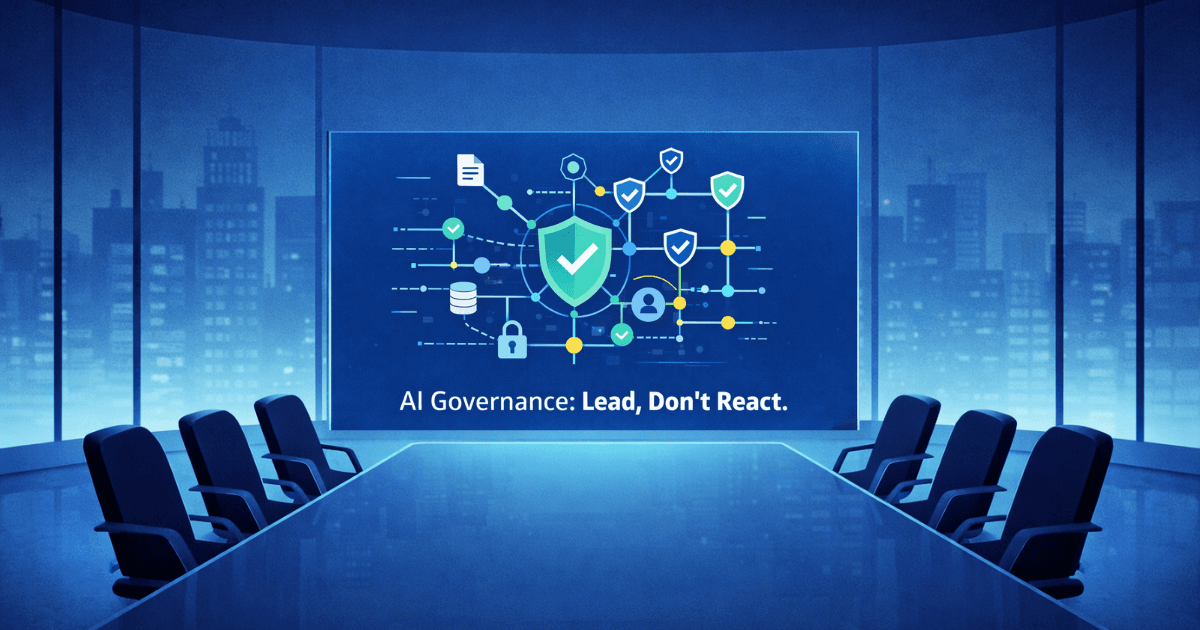
Artificial intelligence is no longer a pilot initiative reserved for innovation teams. Business AI adoption has moved into daily operations, often without a formal rollout or executive directive.
Across industries, teams are integrating AI tools into their workflow to increase efficiency and reduce repetitive tasks. Marketing departments accelerate content creation. Operations streamline documentation. Sales teams refine messaging in seconds. Employees are using AI because it helps them move faster.
According to the latest McKinsey State of AI report, AI adoption continues to accelerate across sectors, with measurable performance gains for organizations that integrate it effectively.
The opportunity is real. The leadership question is different: do you have AI governance in place to guide how it’s being used?
The Business Case for AI Adoption Is Strong
Business AI adoption continues to rise because the results are tangible.
Research from the Microsoft Work Trend Index shows that employees are bringing AI tools into their workday faster than organizations are formalizing policy around them. Productivity gains, faster research cycles, and improved responsiveness are driving rapid integration.
When implemented intentionally, AI increases capacity without increasing headcount. Experienced employees can focus on strategic work instead of repetitive tasks. That upside explains the momentum. What often lags behind is AI governance.
When AI Usage Outpaces AI Policy
Momentum alone doesn’t create risk. Lack of structure does.
Inside many companies, employee AI usage expands before leadership defines clear guardrails. Informal encouragement replaces documented standards. Assumptions replace oversight.
Without a defined Employee AI policy, employees are left to answer critical questions on their own:
- Can client information be entered into public AI platforms?
- Which AI tools are approved?
- Are proprietary documents safe to upload for summarization?
- Who owns oversight of AI risk management?
Small convenience decisions compound quickly. A spreadsheet gets uploaded for analysis. A contract is pasted into a chatbot. A proposal draft is refined using a public AI assistant.
These actions rarely stem from bad intent. They stem from speed.
AI governance is not just a technology issue. It’s a leadership issue.
AI Governance Is Now a Leadership Responsibility
Strong AI governance does not restrict innovation. It creates clarity.
The National Institute of Standards and Technology (NIST) has released an official AI Risk Management Framework, recognizing that responsible AI implementation requires structured oversight. Governance is no longer optional at the enterprise level, and it is increasingly relevant for small and mid-sized businesses.
Effective AI leadership includes:
- A documented AI policy
- Clear data protection boundaries
- Defined ownership of oversight
- Alignment with broader cybersecurity standards
- Ongoing evaluation of AI risk exposure
An AI policy should not operate in isolation. It must align with your broader cybersecurity strategy and overall managed IT services approach to ensure data protection and operational stability.
When AI governance integrates into your existing technology framework, employees gain clarity and confidence. Risk becomes manageable. Innovation remains intact. Organizations that see long-term gains from AI share one common trait: intentional leadership.
AI Risk Management Starts With Visibility
Many executive teams are not resistant to AI. They lack visibility into how employee AI usage is unfolding inside their organization.
In conversations with business leaders, common patterns emerge:
- AI tools are being used informally
- No formal AI policy has been documented
- Vendor data retention policies have not been reviewed
- AI risk has not been included in a recent technology risk assessment
This does not signal failure. It reflects the speed of innovation.
AI governance maturity develops when leadership evaluates exposure, defines boundaries, and assigns ownership. Without visibility, assumptions fill the gap. With visibility, strategy takes shape.
Building an AI Policy That Protects Momentum
An effective AI policy balances enablement and protection. It clarifies what data can be used, which tools are approved, and how oversight is maintained without slowing productivity.
A practical AI governance framework typically includes:
- Defined Acceptable Use: Clear guidance on how employees can use AI tools within daily workflows.
- Data Protection Standards: Explicit boundaries around client data, financial information, and proprietary assets.
- Vendor Risk Review: Evaluation of how AI providers store, retain, and process submitted information.
- Monitoring and Accountability: Alignment with your broader IT governance framework and managed services oversight.
When those elements are in place, AI becomes a competitive advantage instead of a compliance concern.
Where Does Your Organization Stand?
AI is reshaping how work gets done across every industry. Adoption is accelerating, and the operational impact is measurable.
The question for leadership is not whether AI should be used. It is whether it is being guided.
Do you have a documented AI policy in place? Is employee AI usage aligned with your cybersecurity standards? Has anyone formally evaluated your AI risk exposure? Is ownership of AI governance clearly defined?
Without clear answers, organizations rely on assumptions. With clarity, they operate with confidence.
Get Clarity Now.
AI is already influencing how your team works. Strong leadership ensures it strengthens your business instead of introducing avoidable exposure.